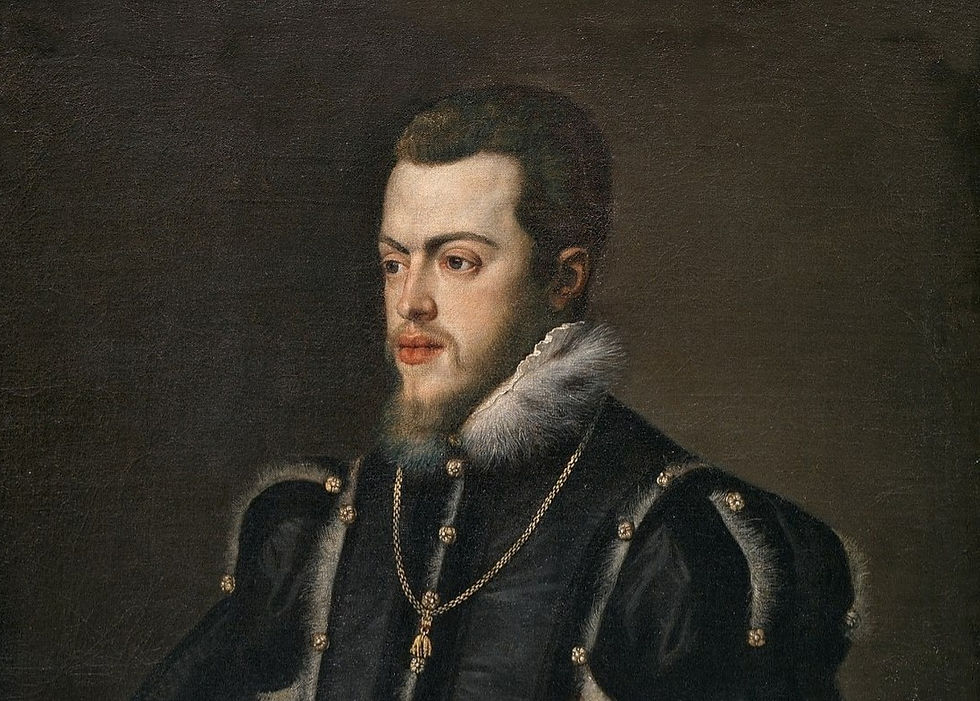
KING PHILIP II
Monarch of Spain

BACKGROUND
Who was King Philip II of Spain?
Born on May 21, 1527, in Valladolid, Spain
Son of Holy Roman Emperor Charles V and Isabella of Portugal
Family had a lot of power and land from royal ancestry
When did he come to power?
In 1540, Philip received the Duchy of Milan from Charles V, giving him the cities of Naples and Sicily
On January 16, 1556, Philip acquired the throne of Spain after his father was unable to perform duties
Inherited a unified Spain including Valois of Burgundy, Habsburg of Austria, and Trastámara of Spain
Were there any wars or major events that impacted his upbringing?
Roman Catholic clergymen educated him
influenced the policies he made as king
Was educated heavily on beliefs inspired by the Renaissance
Mother died when he was twelve as a result of a miscarriage
forced him to be independent
ROLE IN POWER
What type of Economic Policies did he have in his kingdom?
In 1556, Phillip II inherited an economically weakened empire that needed rebuilding
Three Graces: taxes imposed to finance wars, costing as much as 1.4 million ducats in the 1590s
Population growth and unproductive farming led to imported wheat and high prices of goods
Spanish gold was no longer in as high demand
foreign competition
Indies’ colonies capability to provide for themselves
Did he get into any wars while in power?
Heavily taxed and converted the Dutch, leading to the war for Dutch Independence from Spain
also known as the 80 Years War
Fought the Ottoman Empire and won against them in 1571 in Lepanto
Anglo Spanish War (1585-1604, Spain, England, France, Ireland) began with more conflict and hostility towards Protestants
Failed armadas sent in 1588 to fight England, then failed again in 1596 and 1597 due to bad planning
Were there any issues with religion happening in Spain?
Virtually no religious freedom in his territories, and considered himself the Champion of Catholicism
Protestants viewed him very negatively, causing some Spaniards and others to go against him
Killed many Spaniards and others of heresy; even jailed his own son for interacting with Protestants
How was he an absolute ruler?
Believed it was his divine right to convert everyone to Catholicism
There were no checks and balances when he made the decision of taxing common people for war efforts
All powers were given to him regarding the control of nations
What struggles did he face?
Created a government where no one trusted each other
being the reason for rebellions and wars
Declared a state of bankruptcy multiple times throughout his reign
Religious interest often conflicted with the advancement of the Spanish empire

IMPACT
What major impact did King Philip II have?
Gained control and created political stability within many places
1554 - Philip married Mary I of England
became a joint sovereign of England until Mary’s death in 1558.
Married Anna of Austria in 1570, creating a political tie
Received the Franche-Comté by marrying Elizabeth of Valois
Married Elizabeth of Valois, daughter of Henry II of France, in 1559
ended the open wars between Spain and France for a generation
What lasting impact did he make?
Catholic reformation in Europe still continued by successors
Left Spain broke like his father did
Expressed ruthless power as a model to be carried on by other rulers
Expanded his country and helped acclimate to the new world
Did he strengthen or weaken the empire?
Weakened
War took a lot of money from peasants, the hard-working backbone of empire, and turned them against him
Was greedy and took riches for himself instead of spreading wealth among his people
led to four bankruptcies throughout his time of ruling
Banned foreign students from his land
diminished diversity and leaving a bad reputation on his identity as a monarch
Claimed a lot of land, but didn’t have the political stability to control them
INTERESTING FACTS
King Philip II had 4 wives, and his first wife was his cousin, Maria Manuela
Don Carlos, his first son, had mental instability and wasn’t capable of taking the throne
possibly due to inbreeding
As a young child, Philip always struggled with learning foreign languages, and as a result, never mastered any
The Philippines were named after King Philip II


